Wednesday, November 7, 2012

New York in 1912 at Museum of the Moving Image


As a silent film historian and native New Yorker, I highly recommend viewers in the NYC area check out the exciting series coming to Museum of the Moving Image in Astoria, Queens, this weekend.

Curated by historian Richard Koszarki, the screenings feature many films produced one hundred years ago, in 1912, by prominent filmmakers of the day. It’s a wonderful opportunity to see rare archival prints of films, all of which were produced right here in New York City in the same year. The films also feature live accompanist by Donald Sosin. Below is a rundown of the screenings.

For more information, visit the museum website.


A Night at the Nickelodeon

Saturday, November 10, 4:00 p.m.
Despite the release of a handful of feature-length films, most movies in 1912 still lasted only ten or fifteen minutes. Thousands of motion picture theaters across the country did their best to offer a balanced program of fiction and non-fiction, comedy and melodrama, with most of them changing the bill every single day.
Program runs approximately 70 minutes.

A Vitagraph Romance, How a Mosquito OperatesFlo’s DisciplineWinter Visit to Central ParkThe Land Beyond the SunsetAn Unexpected ReceptionA Grocery Clerk’s Romance.


Classical Cinema

Saturday, November 10, 6:30 p.m.
With theater owners doing their best to attract a more upscale clientele, 
producers responded by plundering history and literature. High-class 
French and Italian imports provided the model, and by 1912 most studios 
were looking to the classics to add a veneer of respectability to their 
programs of one-reel comedies and melodramas. 


Program runs approximately 70 minutes.
A Japanese IdyllDr. Jekyll and Mr. HydeThe Cry of the ChildrenRobin Hood

Griffith in Fort Lee

Sunday, November 11, 3:00 p.m.

Although he was already spending half the year in California by 1912, 
D. W. Griffith still spent every summer and fall in New York. Avoiding the
cramped Biograph studio on East Fourteenth Street whenever possible,
Griffith and his company preferred to take the ferry to Fort Lee where
exteriors for all the films in this program were shot (even those that seem
to have been shot on the Lower East Side). There he could work on
uncrowded streets and tap into a supportive infrastructure of local hotels,
businesses, and movie-struck extras, treating the town as his personal
back lot. 

Program runs approximately 85 minutes.


The Narrow RoadAn Unseen EnemyThe Painted Lady,
The Musketeers of Pig AlleyThe New York HatThe Burglar’s Dilemma 


Alice Guy Blaché, Queen of Solax

Sunday, November 11, 6:00 p.m.

The first woman to produce and direct her own films, and the only one 
ever to own her own studio, Alice Guy Blaché had been directing films in
Paris since before the turn of the century. Sent to America with her husband,
Herbert, to promote Gaumont’s talking film system in 1907, she saw the
opportunity to launch her own production company and three years later
opened the Solax studio in Flushing. As business took off, she built an
impressive new Solax on Lemoine Avenue in Fort Lee, which the company
moved into during the summer of 1912. But even when Solax was releasing
two or three films every week, this busy studio head still found time to direct
most of them herself.

Program runs approximately 85 minutes. 
A Fool and His MoneyFalling LeavesAlgie, the MinerThe Detective’s Dog,
The Girl in the ArmchairCanned HarmonyMaking of an American Citizen

Saturday, October 20, 2012

Silent NYC Animation on Turner Classic Movies!


Tune in to Turner Classic Movies on the evening of 
Sunday, October 21, 2012

The news has been circulating for some time, but it's with great pride that I finally report here that Turner Classic Movies will be broadcasting some rare, early New York Animation from the collection of yours truly. It's a rather rare event, and one that's wholly exciting: early, rare, and obscure animation is being spotlighted on a major television channel. Turner Classic Movies is one of the finest outlets for this type of material, as it's the most highly-regarded source for classic and early film on television.

Meeting and talking with TCM staff led to the concept of their showcasing some items from my early animation collection. With the help of close friend and research colleague David Gerstein, I put together a selection of films that will be outlined below. Gerstein was also responsible for research and overseeing musical scores, which were beautifully executed by Robert Israel and Ben Model. It's incredible how well a new musical score can enhance the experience of viewing a silent cartoon.
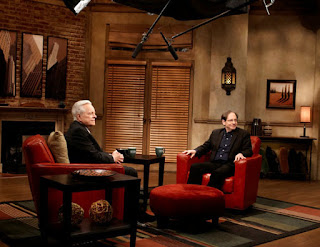
Jerry Beck (r) on the TCM set with host Robert Osborne (l)
In a very appropriate turn of events, though, TCM staff connected with Jerry Beck--practically a celebrity in the field of animation history research--who consulted with them to turn this broadcast concept into an entire evening of animation showcases. As you'll find in Jerry's introductory posting here, other highlights of the evening will be Max Fleischer's landmark feature films, as well as a selection of UPA cartoons topped off with the broadcast of Lotte Reiniger's historic, early silent animated feature The Adventures of Prince Achmed (1926).

Now, for the details Cartoons on Film blog readers want to read...some notes on the cartoons showcased as part of the New York Animation hour. Like the other showcases for the evening's broadcast, this segment is prefaced with a brief conversation between TCM host Robert Osborne and Jerry Beck, who reappear to introduce different sections of the show.

Please see the bottom of this post for a special message!

Silent Era Animation from the collection of Tom Stathes at 12 midnight Eastern/9pm Pacific

All films have been digitally remastered, in HD, from 16mm film prints. Film scans and restoration by Process Blue. Further post production, editing and restoration carried out by Steve Stanchfield of Thunderbean Animation; to you I am extremely grateful.  
The Farmerette
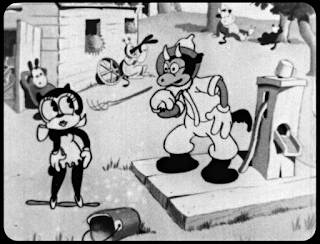
The program begins with The Farmerette (1932).  Produced by the Van Beuren Studios as part of the Aesop's Fables series, The Farmerette was chosen as the header for this program as a symbol for familiarity; the type of early black and white cartoon most would associate with the early New York animation studios. The storyline is simple: a dismayed farmer calls in a 'Farmerette' to perk up the depressed, despondent animals on his farm who refuse to work. The Farmerette, upon arrival, gets the animals' attention quickly--she sings, dances, and is a parody (or more likely, a blatant copy) of then animation sex symbol Betty Boop. The animation is sometimes crude, the drawings are sometimes laughable--as is the case for much Van Beuren product, but the cartoon is funny as hell and the music is catchy, to say the least. Although the subject matter deals with 'down home' farm and animal troubles, The Farmerette is a prime example of the New York animation output of the early 1930s, and it serves as a segue to go back in time to the earliest days of animation production in this city.

From the beginning...
Lightning Sketches
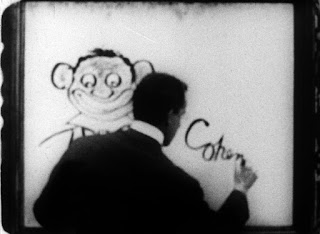
Lightning Sketches (1907). Produced by J. Stuart Blackton at Vitagraph Studios. This very short film is one of the earliest, and few, surviving examples of a filmed 'chalk talk.' Early studios like Edison had filmed extremely brief clips of artists, such as Flushing, Queens resident R. F. Outcalt of Buster Brown fame sketching on a drawing board. In a similar but more notable case, Blackton took a popular vaudeville act of the time, the chalk talk, in which an artist draws humorous sketches for the audience, and adapted it for the screen. By using basic editing-in-camera techniques, Blackton produced crude, novel animated effects concerning the subjects he has drawn, such as a caricature of a man smoking or a seltzer bottle spritzing its contents into a glass of wine. Lightning Sketches, although extant for some time, has been a rarely-seen Blackton entry post-dating his famous and oft-seen Humorous Phases of Funny Faces (1906). Music by Robert Israel.
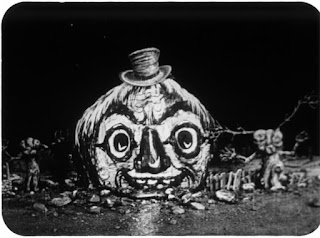
The Haunted Hotel
The Haunted Hotel (1907). Produced by J. Stuart Blackton and Vitagraph Studios. The Haunted Hotel is one of several early films, produced by various studios in America and abroad, that depicted the then-popular vaudeville act of the same title. A wanderer in the night, played by William V. Ranous, finds himself in a haunted hotel. Mysterious figures appear and objects in the room move on their own; on stage this was achieved using thin wires, but again basic editing was used for the illusion of things moving or disappearing in this early film. A mostly live-action film, this Vitagraph novelty is especially notable for its extensive stop-motion animation sequence. A loaf of bread is cut by a knife, a drink is poured, all on their own. A toy clown--clearly from the Humpty Dumpty Circus, a popular toy set of the early 20th century--walks around the table without any aid and smokes a pipe. Ranous' character, continuously flabbergasted throughout the film, suffers a most unfortunate fate at the end of this surreal early trick film and stop-motion animation gem. Music by Robert Israel. Special Thanks to the Library of Congress.
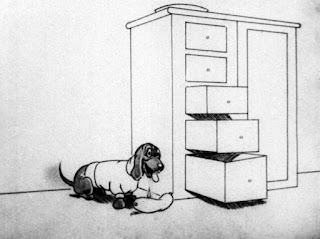
The Artist’s Dream

The Artist's Dream (1913). Produced by J.R. Bray. Proudly presented by yours truly as well as the Bray Animation Project, this film was Bray's first successful animation project. For a few years prior to 1913, Bray had attempted animating his wildly popular Little Johnny and the Teddy Bears comic strip. He later reminisced, albeit glumly, that it would take far too much time and effort to make an animated cartoon--without shortcut techniques--especially considering that there were backgrounds and more than just one character to reproduce in each frame. By 1913, Bray had discovered (and patented) a process by which backgrounds could be printed and only the areas of the frame or character(s) that needed to move in a particular frame could be painted or drawn on top of that sheet, accordingly. This process was likely 'adopted' from Winsor McCay by Bray after a visit to McCay's studio, and the infamously litigious Bray later took legal recourse against McCay who did not take out a license on Bray's patent. In this novelty film, featuring live-action sequences intercut with animated segments, Bray plays an artist who draws a dachshund on his easel. Shocked, upon returning to the easel various times after the dog has either moved around or stolen sausages placed above a cupboard (during the animation sequences), Bray summons a friend to take a look at the situation. In the final animated segment, the dog explodes after eating more sausages. It turns out this was all a dream--at the end of the film, Bray is awoken by his actual wife, Margaret, who thinks he should quit napping and get back to work. The Artist's Dream was a highly exciting offer to Pathe at the time, who did well with the film, and signed Bray on to produce many more animated cartoons at a time when there was no such product regularly offered in theaters. Dream was the beginning of an animation empire, and more about its (and Bray's) significance can be found at the Bray Animation Project website. In the 1940s or 50s, Bray gave the film an alternate title; The Dachshund and the Sausages, and replaced all of its main and inter-titles. New close-up shots of the dish containing sausages were also added to aid continuity in viewing an already aged and problematic print. These changes are present in this newly remastered version, as no original version of the film has surfaced to date. Music by Robert Israel. Special Thanks to Cinematheque Quebecoise.

Pioneers
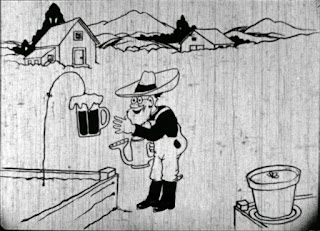
Down on the Phoney Farm
Down on the Phoney Farm (1915) Produced by Paul Terry. Phoney Farm is a relatively new and highly significant discovery made within the last two years. It had been assumed that none of Terry's earliest animated works survived, at least none of the cartoons predating his Farmer Al Falfa series produced at Bray Studios (which now survives almost in its entirety). The find occurred when David Gerstein and I were viewing a reel of unidentified film clips preserved at the Library of Congress. After some pondering, initial excitement and then checking against period reviews, it became obvious that the primitive fragment of a crude farmer character we were watching was indeed Terry's second film, Down on the Phoney Farm. I was unaware that Farmer Al had been featured in an animated cartoon prior to the Bray series, so this was indeed an exciting find. Farm was the second of two cartoons distributed by Thanhouser in 1915, after an unsuccessful earlier attempt that Terry made to distribute his pilot works. What is presented here seems to be a fragment, but may be close to complete. Farmer Al waters the ground and out of it grows a frothy mug of beer; shortly thereafter he suggests that his cow drink a cocktail. Al is then chased around the farm, and bows at the end after outsmarting his drunken farm animal friend. The film is both primitive and fascinating; one very intriguing technique used is that a new scene is fully “drawn” from scratch, but without showing an artist’s hand, as was common in certain silent cartoon series. This very historically significant cartoon was the debut of a character whose appearances spanned more than forty years; throughout several hundred cartoons in the silent and early sound period, as well as in color cartoons of the 1940s and new television spots in the 1950s. Farmer Alfalfa is often remembered by some baby boomers as “Farmer Gray,” an alternate character name given by some TV kid show hosts in the 1950s who were showing the silent Aesop’s Fables cartoons as part of their programming. Music by Robert Israel. Special Thanks to the Library of Congress.
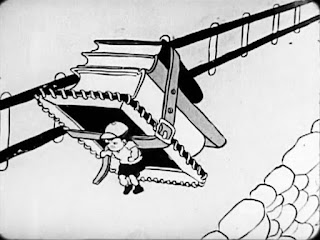
Bobby Bumps Starts for School
Bobby Bumps Starts for School (1917) Directed by Earl Hurd and produced by Bray Studios. In animation history, the Bobby Bumps series is of utmost importance. Bumps was the creation of innovator Earl Hurd, who developed the cel system. The series was actually adapted from an earlier comic strip of Hurd’s, entitled Brick Bodkins’ Pa. Some have described Bobby as the Bart Simpson of the silent cartoon era; and this is a fairly true assessment. The youngster was seemingly always in some kind of trouble; a dreamer and creative type who usually annoyed the family (or their maid Goldie) upon executing various schemes or adventures with his dog Fido. In Starts for School, Bobby would very much rather be playing baseball with Fido than concentrate on his history lesson at school. So, to try and prolong recess, he (and Fido) go up into the bell tower and prevent the bell from being rung by physically hanging inside of it. Mayhem ensues, the bell tower collapses onto his teacher (who has fallen off of the roof!), and the finale of the film finds Bobby and Fido bringing flowers to the teacher’s hospital room. For more information on Bobby Bumps, visit the Bray Animation Project page dedicated to the series. The print presented is a version with television-era main and end titles, circa 1950. Music composed and performed by Ben Model.
Trip to Mars
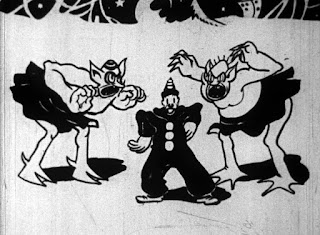
Trip to Mars (1924) Directed by Dave Fleischer and produced by Max Fleischer. An entry in the Out of the Inkwell series, Trip to Mars finds Max sending Ko-Ko the clown up to Mars...against his own will, of course! Out of the Inkwell and its star clown character was, like Bobby Bumps, an immensely significant fixture in the silent-era animation scene. Max Fleischer, an inventor and technical artist, got his start at Bray animating technical and educational films dealing with World War I technology subjects as well as general science films, such as The Electric Bell and Eclipse of the Sun. As far as his early work is concerned, however, Fleischer is best remembered for patenting the rotoscope animation technique, and, as the fable goes, tracing film footage of his brother Dave who was a clown at Coney Island, to produce a new form of animated films. Out of the Inkwell cartoons were first released as part of the Goldwyn-Bray Magazine in the late 1910s and the series eventually led to the Fleischer brothers starting their own studio. The rest of what the Fleischer studio accomplished later in the sound-era--Betty Boop, Popeye, Color Classic, Superman, Gulliver’s Travels--is history. Special thanks to Mark Kausler for providing a circa 1930 reissue soundtrack for this film.

Characters
Fireman Save My Child
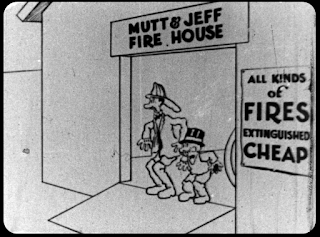
Fireman Save My Child (1919) Produced by Bud Fisher, possibly directed by Charles Bowers. In this early Fox release, Mutt and Jeff are firemen. As one would expect, the wildly famous comic strip characters of the day get into quite jam as firefighters; Mutt spends some time hanging off a building. Jeff is wholly contented with frying some eggs over by the horse-drawn fire truck, and feeding the horse too, of course...while everyone else is consumed by the mayhem. At least two or three hundred Mutt and Jeff cartoons were produced in the silent-era; though most of the pre-1925-1926 Dick Huemer-era titles remaining elusive today. Some have resurfaced in France; though it is difficult to properly identify French prints as no copyright synopses exist (the series was seemingly not copyrighted), release titles given were often vague, and most of these particular cartoons were not reviewed by trade papers of the time. This cartoon was sourced from a 1930s French Kodascope print, with new main, end, and intertitles recreated by David Gerstein. Music by Robert Israel.
The Bomb Idea
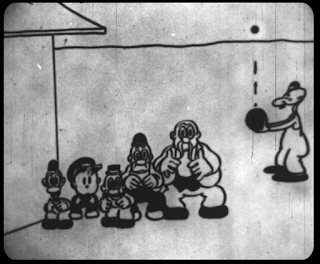
The Bomb Idea (1920) Produced by International Film Service for Bray Studios. Likely animated by Vernon Stallings and/or Walter Lantz. The Bomb Idea is an entry in the Jerry on the Job series, started first at International Film Service and then produced for and released by Bray Studios in 1919 thru 1922. The plot is simple: Jerry, Mr. Givney, and other locals become worried when, after reading a newspaper article about the threat of Bolshevism, a strange man arrives at the New Monia station carrying what appears to be a bomb. As it turns out, the man is a “Champion Bowler” and is wandering around, practicing his bowling skills, but he is scared away after the New Monia clan begin fighting in a dust cloud out of primal fear of this strange, possibly dangerous man. This is one of many examples of Bray cartoons preserved by Keystone Manufacturing Corporation’s 16mm prints produced for home use in the 1940s, and it is presented with its Keystone introduction title accordingly. Music composed and performed by Ben Model.

Scents and Nonsense
Scents and Nonsense (1926) Directed by Bill Nolan and animated by Jack King. As the legend goes, it is purported that in 1948 or thereabouts, one Margaret J. Winkler made a very unfortunate decision. Winkler was a pioneer, perhaps the first female film distributor, who was very active in the 1920s and handled series Out of the Inkwell, Felix the Cat, Disney’s Alice Comedies, and Krazy Kat at one point or another. Unlike a couple of her contemporaries, Winkler did not have the foresight to understand that her old film stock would have value as time slot filler material in the burgeoning new medium of television. Winkler ordered her film negatives destroyed so she could finally eliminate storage bills, and an entire series of silent Krazy Kat cartoons were part of the stock that was burned. As such, most of these cartoons have been difficult or completely impossible to see today, though some have survived in rare, original nitrate prints or very obscure 16mm prints made for home use. Scents and Nonsense concerns Krazy’s scheme to make money by selling furs of captured animals to a Jewish furrier, but his plan doesn’t go so well when he tries to sell a raccoon and then a pig to the gent. Music by Robert Israel. Special Thanks to the Library of Congress.
Springtime
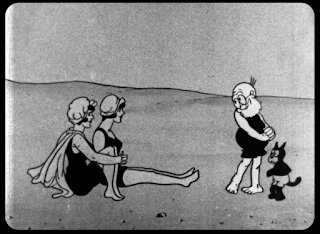
Springtime (1923) Produced by Paul Terry. Earlier in the program, we showcased a very rare and significant Terry cartoon, one of his first and the debut of Farmer Alfalfa. The program concludes with a more familiar Farmer Al; that of his 1920s incarnation as part of the Aesop’s Fables series. In this very funny entry, Farmer Al is dismayed that he can’t get the attention of a couple women at the beach. When the women ogle at a bow-legged man and then a “sun-burnt” gentleman, Al sets out to destroy himself with the aid of a cat sidekick in hopes of mimicking the other men so that he, too, could hopefully catch a stare from the ladies. The plan fails, of course, but the cartoon doesn’t end before Al winds up roasting on a spit and gets chased by a lovesick monkey who confuses Al for a long-lost mate. The print presented was originally part of the Kodascope Film Library, an early film rental service and is presented with its 16mm rental titles. Music by Robert Israel.

It’s time for that special message I mentioned earlier!

If you support seeing this kind of material on television, please make your concerns known. Turner Classic Movies relies heavily on viewer feedback and sentiments expressed on their online forums. If you enjoyed this broadcast and want to see more, definitely say so here. Jerry Beck also strongly urges you to share your thoughts with TCM. I thank you kindly for your support!

For those of you who caught this broadcast, I hope you enjoyed it thoroughly and were able to appreciate the lovely high-def transfers, restoration work, and brilliant new music scores. Any of you who have questions or concerns about these early cartoons or my work in collecting, archiving and sharing them, can definitely contact me at cartoonsonfilm (at) gmail (dot) com.

-Tom Stathes

Wednesday, October 17, 2012

Fundraiser: Help Preserve Two Rare Bray Cartoons!


Dear friends, fellow researchers and animation fans...

Many of you are probably familiar with my Bray Animation Project. Over two hundred cartoons have already been collected, and a LOT of time is spent seeking new titles to add to the film collection. However, the film prints found are not always in good condition. Such is the case for two very rare Bray cartoons from the mid-1920s.

Col. Heeza Liar’s Knighthood (1924) and Dinky Doodle in Just Spooks (1925) are held here in, so far, seemingly the only known film prints. Both of these films are early Walter Lantz directorial efforts but, unfortunately, these seventy-year-old 16mm prints are suffering from a progressive form of vinegar syndrome and they may not be easily copy-able for much longer. Thankfully, though, the picture quality of both is really very nice, and they are definitely worth preserving due to the scarcity of prints of these particular two titles. They may turn up again in other, old 16mm prints, but we never can know the condition of film prints that will be found in the future. Why leave the survival of these two cartoons to chance?

Like many of the other Bray cartoons in the collection, they should be copied to a digital HD format and should be made accessible to the public at some point. However, I don’t consider digital copying to be a proper preservation. These should be preserved in the actual format in which they currently exist--16mm film. Thankfully, this is not impossibly expensive to do, but it is still too costly for me to do on my own. So, I’m looking to the community here for some help and I think we’ll all benefit! 

What I’d like to do as an incentive for you to help is offer my Tom’s Vintage Film/Cartoons On Film unrestored silent animation DVD collections to all at a sharp discount of 3 titles for $20. That’s three DVDs for the price of one. The list of DVDs can be found at http://cartoonsonfilm.com ...this would be a great opportunity for some of you to add a bit more early animation to your collections. 

Some more aspects of the offer:

-This offer is only good for DVDs with a catalog number, not letter code. For instance, discs TS-01 thru TS-45 are part of the offer, but not discs like TS-H or TS-W. 
-Discs that are part of this offer will come in paper sleeves, not standard plastic cases. I will still include the plain DVD case paper inserts with title info if needed.
-I ask for a minimum order of $20.
-For orders of $40 and up, shipping within the US will be free.
-Paypal is strongly preferred.
-You’ll also receive a DVD copy of the two Bray cartoons that we’ll be trying to preserve!

About $500-700 will be needed to make this preservation project a reality. I’m hoping that as a community, we can all come together to make this happen...and I thank you all in advance for your help!
I’ll be pushing this fundraiser throughout October/November and will see how possible preservation will be in the beginning of December.

For all inquiries, reach me at cartoonsonfilm (at) gmail (dot) com

Many Thanks,
Tom Stathes 

Saturday, September 1, 2012

Come see classic cartoons on September 22nd!


SUNNYSIDE GARDENS PARK presents
FLICKS IN THE GARDEN: A FAMILY MUSIC AND FILM FESTIVAL
Saturday September 22, 2012 at 6:30

Contact:
Emilie McDonald/Tammy Arnstein
Producers, Flicks in the Garden


Sunnyside Gardens Park presents Flicks in the Garden: A Family Music and Film Festival on Saturday September 22, 2012. Starting at 6:30 pm, upbeat music will fill the night air as the program kicks off with tunes from a local band. Kids and parents are invited to jump and twirl, then settle down with a slice and some popcorn.

Beginning at dusk we will showcase kid-friendly vintage animation films from the collection of Queens native Tommy Jo Stathes.  Mr. Stathes runs the blog and website CartoonsOnFilm.com, which celebrates early animation. The films shown will be rarely-seen cartoons from 1930s and 1940s, including Along Came A Duck (1934), House Cleaning Blues (1937) and Date to Skate (1938).

Flicks in the Garden is a volunteer-run arts festival established in 2011 to cultivate and recognize Sunnyside film and music enthusiasts and locally-based filmmakers and musicians. Co-organizers and filmmakers Emilie McDonald and Tammy Arnstein have most recently worked together on Crossing the River (www.crossingtheriverfilm.wordpress.com), a narrative short film currently in post production.

Flicks in the Garden is made possible by the generous support of Council Member Jimmy Van Bramer's office, the Sunnyside Shines BID, and the Sunnyside-based businesses Go Natural, 99¢ Pizza Dealz, The Dog and Duck, Tiny You, and Pink Icing.

DATE:                                     Saturday, September 22, 2012
TIME:                  Music at 6:30 pm. Films begin at dusk. There will be a 15-minute intermission.
LOCATION:                  Sunnyside Gardens Park, 39th Avenue at 49th Street, Sunnyside, Queens
RAIN DATE:                  Sunday, September 23, 2012
ENTRY FEE:                   Suggested Donation: $10/$5 for park members
SEATING:                  Bring beach towels, blankets, or low chairs.
FOOD:                  Pizza, popcorn, and drinks will be sold.
DIRECTIONS:                   Sunnyside Gardens Park is on 39th Avenue at 49th Street, three blocks north of Queens Boulevard or Roosevelt Avenue. It is accessible from the No. 7 train (46th or 52nd Street stations), Q32 or Q60 bus, and the Long Island Railroad’s Woodside station.

Monday, July 16, 2012

Dr. Film Needs Your Help!


In certain fields, there are important figures whose work tends to be under-celebrated. This is absolutely the case for film historians and preservationists. While some have achieved relative fame and recognition in our circles, for every well known film historian there are probably dozens who enjoy only slight recognition while they are doing very important work for our film heritage. Eric Grayson, also known as Dr. Film, is one such historian and preservationist who has been working in this niche for years and it's my pleasure to help spread the word about a couple projects he is working on.


At this current time, Eric is looking to do a specific kind of restoration on one chapter of King of the Kongo. Now, most of you know my specialty is early animation though I do enjoy and appreciate other silent films and early sound films as well. However, I'm not terribly familiar with serials, and I'm fascinated to know that King of the Kongo was the first serial to be released with sound. Eric explains more about its historical significance here.

As it turns out, Eric has a complete silent print of the entire feature in 16mm. Ron Hutchinson of the famed Vitaphone Project has now located some sound discs from the serial and these elements combined provide sufficient materials to fully restore Chapter 5 of the serial to its original sound form. By way of Kickstarter, Eric is looking to raise funds so that a proper 2K digital scan can be made from his film print and a new 16mm negative can be made so that the picture and sound elements can be reunited in new 16mm prints. We may live in a digital age but Eric is looking to do the right thing, here...I believe there is nothing better than preserving film on film. I highly recommend that anyone who is interested in helping preserve film history help Eric by giving a contribution (and you can get some cool stuff in exchange!). Please check it out--there are only several days left to contribute!


I'll be reporting a bit more on Eric Grayson's work in the future but that's that for now. Please have a look at the fundraiser and consider helping Dr. Film!

Wednesday, July 4, 2012

Happy 4th of July from the Bray Animation Project

It's time to celebrate Independence Day 2012 with an early cartoon probably not seen publicly since the 1950s. That would be Bobby Bumps' Fourth (1917) directed by Earl Hurd at the Bray Studios.
This is probably the first 4th of July-themed comedy cartoon.


This is Bray's circa 1949 TV version of the cartoon. Looks like J.R. used at least two different sources for footage in compiling this version.

Sadly, many of Bray's own nitrate masters (and those elements he called back from home movie distributors like Keystone Mfg.) that were sought to be used in compiling the TV package were already "melted" and suffering from other condition problems by the late 1940s. Thankfully, several dozen titles still made the cut.

For further reading about the distribution history of Bray cartoons, please see this page on the Bray Animation Project website.

Friday, June 29, 2012

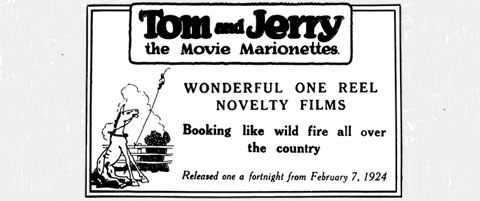
The First "Tom and Jerry" Cartoon Finally Surfaces

(Photo courtesy of Lee Roop)

As I always say, lost films truly cannot be considered "lost" until every square foot of the Earth has been searched with a fine-toothed comb. In many cases, "lost" films are right under our noses: in archival or private film collections, waiting to be identified and discovered by those who know something about the film. This week, one fine example has come to light.


For years, colleagues and I were very curious about an early series of cartoons titled "Tom and Jerry." Those of us in the know had already been amused by the fact that while there was the famous cat and mouse duo of the 1940s and beyond, Van Beuren boasted a Mutt and Jeff-like duo with the same name in the early 1930s. However, there was this even earlier series, referenced in at least a couple filmographies of silent animation, and you can bet we really wondered what the films were about and what this duo looked like.


Us early animation fiends were finally thrown a bone when on February 22, 2010, Jerry Beck reported that Lee Roop was preparing a book on his grandfather, J.L. Roop, the man who animated these mysterious films. For me, at least, it was at this time that I discovered the earliest Tom and Jerry cartoons were actually stop-motion films. Jerry, on behalf of Lee Roop, shared a few lovely images and tantalizing information about J.L. Roop's mysterious stop-motion films. My mouth watered a bit as I happen to love stop-motion films, especially early ones with curious looking characters and crude movement. I've always looked at stop-motion films as a sort of view into an alternate reality in which drawn or "flat" animation cannot apply itself.

I come across many interesting tidbits of information and as readers of this blog already know, many interesting and rare films from the early days of animation. Sometimes, though, new finds are simply announced to me by friends and colleagues who notice items of interest online or elsewhere. Last night, my good friend and research colleague David Gerstein shared the big news with me: by way of Jonathan Boschen, another animation historian and enthusiast, a link to the Tom and Jerry film Gasoline Trail (1923) had been posted on the Internet Animation Database forums. It was put online by none other than Prelinger Archives, a massive collection of offbeat films (usually educational and industrial in nature) that had been collected by preservationist Rick Prelinger.

I've said enough, and as you can imagine, I was both shocked and delighted by this revelation. Without further ado, watch the film! Thanks be to Rick Prelinger...and all those who collect forgotten, orphan films and eventually get to share them with the precious small audience that exists for this type of material.


Thursday, May 31, 2012

Bray Animation Project: 1st Anniversary!

It's been a fun and fruitful year for early animation "historianism." Back in June of 2011, the Bray Animation Project website launched after quite some time in the making. Twelve months later--largely as a direct result--great strides have been made in locating previously lost and unknown Bray cartoons, as well as accessing films that have been held in archives for years. While the website has been a handy research tool for ourselves and our colleagues, it has also proven a useful vehicle for alerting the community at large to our interests. Valuable information and important artifacts have been sent my way thanks to the site, and I'm grateful to everyone for such a warm response.

In the very near future, I expect to announce some very exciting plans that will allow the general public to finally see some of these films in high quality versions. The Bray project is not merely my personal collecting venture; it's an effort that seeks to share the films and present them in context, an effort that will take time and funds.

While we wait for these announcements, I'd like to share some highlights of films that have been located or accessed and copied in this past year. The following are samples of some two dozen or more films that have surfaced since the website's launch...and the trend continues; finds are being made and access is being achieved regularly.

The Old Swimming Hole (1919)

An entry in Wallace Carlson's Us Fellers series at Bray, using his Dreamy Dud character which began earlier at Essanay. New 16mm print of this Bray TV version acquired through the courtesy of Cinémathèque Québécoise.


Bobby Bumps Throwing the Bull (1919)

The last cartoon Earl Hurd produced at Bray. Hurd took Bobby Bumps to Paramount and later Educational, finally retiring the character in 1925 after ten years on the screen. HDCAM transfer of this abridged and amber-tinted 1920s 16mm Filmo Library print acquired through the courtesy of the Library of Congress.


Action of the Human Heart (1920)

This film is one of many animated educational films that were produced at Bray. HDCAM transfer of this 1920s 16mm print acquired through the courtesy of the Library of Congress.


The Dummy (1920)

The late 1910s saw Jerry on the Job, Happy Hooligan, Judge Rummy, and Krazy Kat cartoons being produced for Bray under an agreement with Hearst's failing International Film Service. The deal also saw the production of three little-known Shenanigan Kids cartoons. "Shenanigan" was an alternate name given to the ever-popular Katzenjammer Kids comic strip in the late 1910s.  After the Bray Project launch, artist and animation historian Milton Knight alerted me to the existence of Shenanigans' The Dummy on an old VHS tape--and purely by luck, a 16mm print surfaced soon thereafter. This vintage 1950s print was obtained from a 16mm film print dealer. It was originally struck by a notorious bootlegger who sold timeslot fillers to early television stations.

                                         *****************************************

On an even more exciting note, I reported to the Bray site's discussion board in April that the Bray Farmer Alfalfa series had finally been collected in full--the first Bray series to be completely reassembled, and an exciting moment. Some of you might be thinking that it would be wonderful to see these films, and you need not worry--it will happen! As a preview of what will soon be announced, please have a look at the two videos below.

Both are versions of Farmer Alfalfa's Revenge (1916). The first is a version that has circulated for decades; while having its original main title, it is an abridged version that was marketed in 100 foot 16mm form by Keystone Manufacturing Corp. in the 1940s. In another twist of luck, a brand new print has been obtained from the circa 1949 Bray TV 16mm negative that has survived in obscurity all these years. While this second print no longer has its original titles, it is complete at almost double the Keystone print's length. As I now have both, it will be no problem at all marrying the original titles with the complete film--which looks great to boot!


Here's looking forward to another fun-filled year of research, important acquisitions, as well as big announcements that will benefit all of us!

-Tom Stathes

Saturday, May 19, 2012

New Tom Stathes Screenings Coming Up!

Hello Friends, To all who live in or will be visiting the NYC area, please take note of two upcoming events that you'll be sure to enjoy!

Old Timey Slap Dash
   
Saturday, May 26th - Old Timey Slap Dash @ 8pm 

:: CARTOONS Tom Stathes 
:::: MUSIC Honest Pete 
:::::: FILM Movie Mike presents classic films ... 
:::::::: DIARY Ellen LaVeyra presents excerpts from a 1920s diary 
:::::::::: POETRY Lauren Raheja 

We're going old school! Really old school! Get psyched, and prepare your costume for an old timey good time with Slap Dash. COSTUMES ARE HIGHLY ENCOURAGED. Free home brewed beer by Honest Pete. 

LaunchPad 721 Franklin Avenue, Brooklyn, NY 
2/3/4/5/C to Franklin Ave. | 8PM | FREE | ALL AGES 

Website: http://slapdash.terribleinformation.org/ | Phone: 718-928-7112 

======== WTF IS SLAP DASH??? ======== Slap Dash is a monthly series that brings together different art forms for a semi-cohesive mixed-media extravaganza. If you make art, and you want to show it off, contact us @ slapdashbk@gmail.com

Facebook event here, folks! I will be screening early 20th century animation (mostly 1910s) in 16mm. This is a nice, free event!
**************************************************

The Tom Stathes Cartoon Carnival #10: Made in NYC!

    • Friday, June 8, 2012
    • 7:30pm until 9:30pm
       

  • New York City was the birthplace of American cinema with the earliest animated films created in the 1910s. This edition of The Tom Stathes Cartoon Carnival features selections of early and wacky animated cartoons created right here in New York City. Tom’s show, comprising... oddities from the 1910s through 1940s, is presented in 16mm form with a projector–the technology serving as part of the spectacle–in order to demonstrate how film was meant to be enjoyed. Cinephiles, cartoon and comic fans and lovers of all things vintage are sure to enjoy a Cartoon Carnival!

    Please keep in mind films of an early vintage tend to contain politically incorrect themes. Themes in the films do not reflect the sentiments of the exhibitor or the host venue. Due to the age and fragile nature of antique film prints, there may be momentary technical difficulties during the screening.

    Tom Stathes is a Cartoon Cryptozoologist, with a rare film print collection comprised of over 1,000 shorts. His archive consists of everything from Felix the Cat and Farmer Alfalfa to silent reels from Bray Studios and Out of the Inkwell. A native-New Yorker, he turned his passion for the city’s animation legacy into a preservation mission. With his Bray Animation Project, he has worked with several film and comic historians to document the studios invaluable output. For more information go to cartoonsonfilm.com or brayanimation.weebly.com.

    Hosted by Atlas Obscura and the Obscura Society as well as Observatory of Brooklyn.
    Observatory: 543 Union Street #1E, Brooklyn, NY 11215

    Tickets are $12.00 and can be pre-purchased at the Eventbrite page: http://obscura-society-tom-stathes.eventbrite.com/ 
     
    FACEBOOK EVENT HERE.
     

Sunday, March 25, 2012

Oswald: The undying buzz of discussion

So, we animation historians learned last week that it was Disney who purchased Hungry Hobos for over $30,000. This was a good thing: it showed that a huge corporation was willing to spend some of its lunch money on a very early facet of its intellectual property. This also means we will probably get to see the film in some form. Such is not oft the case for items purchased by private collectors (yours truly excluded!)

I still think having paid such a high price has set a bad precedent for early animated films and art or memorabilia related to those films. Thankfully, auction houses seem to be siding with those of us who feel this way about the Oswald sale. The firms are turning away films and other items being touted by hopeful profiteer collectors/dealers. Good on them.

Discussion on this situation continues to surface on the internet...friend and fellow early animation historian Valentin Moretto of France has now posted about Hungry Hobos on his blog (in French, no less!). Thanks for the mention and link back, Valentin!

Sunday, March 4, 2012

Further Exploits of Oswald the Lucky Rabbit

Close friend and animation historian colleague David Gerstein has once again updated his Ramapith Blog with some fine material. His latest post, as of this writing, concerns Oswald the Lucky Rabbit; a character David has no doubt played a key role in helping to revive.

As readers might know from a previous post here, Oswald has been quite exploited as of late in the form of entertainment memorabilia auctions. David's latest post outlines the most recent problem being apparent forged poster sketches offered to auction houses. Since a 16mm print of the Oswald cartoon Hungry Hoboes recently fetched unreasonably high bids, there has been a great influx of either forged or worthless Oswald material making the rounds. Thankfully these auction houses are now wise enough to consult David on the items' authenticity. I urge readers to check out David's post here.

Tuesday, January 17, 2012

Do you still use a watch?

Guest post by Allan Detloff

Back in my day, in the 1940s, watches were simply a must-have for any woman or gentleman. In any case, unless there was a traditional clock nearby, there would be no other way to tell the time. All it took was to look at your wrist or whip out a pocket watch to find out the hour of the day. Today's young folk are very far removed from that past reality. In fact, I see very few of the younger people wearing watches, or even looking at clocks around the house or in buildings...they can tell the time from their various electronic devices.

It can be said that there's a certain art to looking at a watch and especially being able to read analog time. Watches, quite simply put, are beautiful technical craftsman pieces and exude a charm not found in any digital clock of any sort. So, it bears meaning that any person, such as a reader of a blog like this dedicated to history of some fashion, would be interested in Seiko watches for example. Charm not only yourself; but onlookers as well...to wear a watch, nowadays, is to make an even more striking fashion statement than ever before. And you don't have to be a luddite to appreciate the complex craftsmanship that goes into producing a watch, either.

Thursday, December 15, 2011

The Story of Les Elton

Dear friend; up and coming animation history researcher Charlie Judkins has just posted a great story of Les Elton's career on his blog. Click here.

Elton was involved in some Bray Studios tomfoolery in the 1910s and is best known in animation circles today for his highly bizarre cartoon, Monkey Doodle.


Thanks Charlie!

Monday, November 28, 2011

Sorry, Oswald: You're an Unlucky, Exploited Rabbit.

Earlier today, Jerry Beck posted a Cartoon Brew article regarding the now-viral "lost" Oswald cartoon auction that has been hyped by a successful press release campaign.

The Situation

Staff at the Huntley Film Archives, a private British stock footage firm, located a 16mm print of Hungry Hobos (1928) in their collection several weeks back. Upon doing some preliminary research and realizing the film was not available publicly and had been touted as a "lost film," Huntley staff shared news of the find to industry folk through a listserve frequented by cinema historians and archivists. Reaction was small but definitely excited among the few of us who specialize in early animation...these finds are usually of less importance to others who specialize solely in live action films.

As one might expect, though, several of us in the animation history circles who learned of this discovery were of course excited about it. Until this week.

The Problem, In All Fairness...

We in the archival film community are reminded of the rare nitrate Charlie Chaplin film, "Zepped" (circa 1916), which was also offered by Bonhams in June of this year. This too was sourced from a British collector of antiques. It did not realize the ~$160,000 asking price, and this came as no surprise to us in the field. To assign values to old films, especially exorbitant amounts, has always been a difficult task as these items simply never have been successfully traded at high prices, even between those of us most interested in them. Perhaps it is because typically, we scholars are the only ones interested in old and obscure films; making their value ultimately historical, not financial. They simply do not turn a high profit for us, and so collectors and historians have traditionally traded, bought and sold at relatively low prices when compared to other historically significant pop culture artifacts.

Hungry Hobos is different from "Zepped" in that it is a 16mm safety print. Considering this was located in Great Britain, the print was probably made by Ensign LTD., a firm much like Kodascope Libraries that offered contemporary films for sale and rental in the 1920s and 1930s. Any person could consult Ensign to rent or buy a print of Oswald cartoons as well as many other subjects they carried. This means that unlike nitrate 35mm prints, which too were originally mass produced but then destroyed en masse, Ensign and most other 16mm prints are not entirely unique. While they are rare today, to call a 16mm subject of a mainstream film a "lost" subject is a bit of a misnomer. We too like to use this term in the field, but it better suits commercial endeavors such as the sale of the Oswald film. Unfortunately, though, prospective buyers and the general public would not understand that this print probably is not at all unique. Though, even unique silent animated films are often traded for a few hundred dollars if not less, and certainly not for several thousand dollars.

Silent Cartoon Economics and Oswald

Silent animation truly is an orphan genre. While there are many fans of silent films today, few have more than a passing interest in the animation of the period. Ironically, many silent cartoon series enjoyed widespread broadcasting on 1950s television as it was very satisfactory time-slot filler material. But since then, silent animation has never really enjoyed much of a wholly dedicated fan base. Even few individuals ever really focused on collecting just this one genre of film, either. I can count those individuals on one hand.

Seeing as my focus in collecting and preserving film has always specifically catered to silent animation, I feel more than qualified to comment on the economics and values of these films. It is clear to me that Bonhams did not consult any of the fine gentlemen in our community of animation historians to help formulate an asking price for the Oswald cartoon. That price is absurd to me on many levels, but most obviously because I have been able to amass my library of over six hundred rare silent cartoon subjects for a sum that rivals or is less than the asking price for that one Oswald cartoon. Thus, to me and to fellow industry insiders, the whole situation seems more tongue-in-cheek than anything; if not insulting to those of us who might otherwise be interested in obtaining the film. This is a classic case of poor field research and wide-eyed agents seeing dollar signs swarming around the room.

With regard to Oswald, the character itself has had a very colorful history, moving through several producers and owners. In recent years, Disney reacquired certain rights to the character and put out a very nicely prepared DVD collection of the shorts that could be found in time for its release. The contents of that DVD collection are consulted today when one locates a Disney Oswald cartoon and determines its rarity, as in the Huntley example. I should note that from what I understand, Disney did pay a premium to acquire certain cartoons for its DVD collection--sometimes a few thousand dollars each. Yet we must put this in perspective. A few thousand is still nothing compared to the Bonhams asking price--and a few thousand is still exorbitant to those of us with insider knowledge of more typical silent cartoon prices. A few hundred dollars per film is more the norm for selling and acquiring rarer or "lost" titles. Disney is the exception that proves the rule: the one studio that produced silent animation that survives to this day that still seems interested in archiving its past works. Given Disney's interest, it is somewhat more reasonable to expect that a "lost" Oswald cartoon--as opposed to other "lost" silent cartoons--could fetch a large sum. But still there are limits. My cartoon researcher peers and I have bought several pre-Lantz Oswalds for less than a hundred dollars, including a Disney subject on which only one other original element was known at the time.

In Conclusion

Silent cartoons deserve to be collected easily and seen by interested groups; not traded as fine art pieces, though they should still absolutely be the subject of books and ample academic research. If we come to a point when famous auction houses with powerful press releases bring in high bids on these kinds of items --from individuals who are not involved in this field, clearly--it could further limit the availability of new "lost" film finds for researchers, scholars, and curious individuals in the future. These films were created to be enjoyed and then usually discarded. The goal should be to keep them in a public spotlight for enjoyment, but not to be locked up in vaults with $30,000 price tags...it would be akin to discarding them from the public eye.

As someone who has been a lifelong participant in locating and preserving early animation, I feel right in voicing an opinion that the route this sale could take worries and disappoints me. Working in this field has already been difficult enough considering it is mostly a labor of love that rarely brings much of a rewarding financial return. It is based on that experience, too, that I find the auction route and the expected financial sum worrisome in that it could create a dangerous precedent that could make my work--as an individual and not a firm or archive--more and more difficult.


This one is still missing. Will it one day lead to empty wallets?

Thursday, November 3, 2011

Eyeglasses For the Ages

Post Contributed by Ethan Krall

If you'll have a look around you, clearly many people wear eyeglasses. For most wearers, glasses serve a medical need to compensate for vision problems. For some, they are fashion statements...though this can also be said for those who wear eyeglasses for medical purposes as well. For these two reasons, unique manufacturers like Zenni Optical are producing eyeglasses which fit both medical needs and the necessity for fashionable, attractive specs.

We also know that eyeglasses can very much define a time period. Seen in film, photographs and other popular mediums of the past; it becomes obvious to us that certain styles are apparent in specific time periods such as decades of the 20th century. Today, however, it can be said that eyeglasses are available in the widest variety of styles ever, and for a variety of reasons. There are new methods of producing eyeglasses and new materials being used in their construction. Today, it's also very popular for some people to purchase and wear specific styles of eyeglasses that were popular in past times. These can either be genuine, vintage frames or newly produced frames designed in these older but now very popular styles.

Thankfully, no matter what style suits you best, cheap eyeglasses are available in abundance from several manufacturers. It just takes a little bit of research and trying pairs on to figure which eyeglasses are right for you.